Joshua Okayo Rescued: Abduction During Protests

0


Joshua Okayo

Joshua Okayo Rescued: Abduction During Protests

Joshua Okayo, the Student Governing Council President of Kenya School of Law (KSL), has been found near Margua River in Murang’a County, following reports of his abduction during anti-Finance Bill demonstrations.

Circumstances Surrounding the Abduction

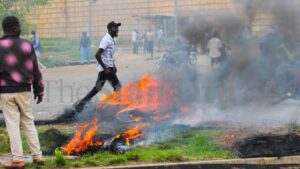
Last Wednesday, amidst escalating protests against the Finance Bill, Okayo’s reported abduction took place by unidentified individuals. Eyewitnesses recounted a tense atmosphere as police attempted to disperse demonstrators.

Discovery and Condition

Authorities discovered Okayo in a distressed state, showing signs of physical abuse. He is currently undergoing treatment at Avenue Hospital in Thika, receiving medical and psychological care.

Confirmation by Law Society of Kenya

Faith Odhiambo, President of the Law Society of Kenya (LSK), confirmed the rescue of Okayo and Regis Wanjala, another student reported missing on the same day.

“We can confirm that two individuals abducted and later dumped at undisclosed locations. Joshua Okayo was found in Murang’a after being taken from Rongai on Wednesday,” Ms. Odhiambo stated.

Denunciation of Abductions

Odhiambo vehemently denounced the alleged abductions, drawing parallels to Kenya’s authoritarian past under former President Daniel Moi.

Call for Justice and Accountability

“The recurrence of abductions and abuse harkens back to the Moi era,” she remarked during an interview on Citizen TV’s JKLive Show, emphasizing the urgent need for transparency and accountability in law enforcement.

Public and Legal Community Reaction

The news of Okayo’s abduction and subsequent rescue has sparked widespread outrage and concern within Kenya’s legal community and among the general public. Many have taken to social media platforms to express solidarity with Okayo and demand justice for all victims of alleged police brutality.

Historical Context and Political Climate

The events surrounding Okayo’s abduction come at a sensitive time in Kenya’s political landscape, marked by heightened tensions over economic policies and civil liberties. Critics argue that the recent crackdown on protests reflects a broader erosion of democratic freedoms.

Government Response and Investigation

In response to mounting pressure, government officials have pledged to investigate the circumstances leading to Okayo’s abduction. President Uhuru Kenyatta, in a brief statement, expressed concern over the incident and assured the public of a thorough inquiry.

Path Forward: Advocacy and Legal Reform

As Okayo continues his recovery, advocates for human rights and legal reform in Kenya are renewing calls for robust protections against arbitrary detention and torture. They stress the importance of upholding constitutional rights and ensuring accountability for security forces.

Leave a Reply

Your email address will not be published. Required fields are marked *

You may have missed

Building Global Bridges for The Kenya We Want At the sidelines of the 74th National Prayer Breakfast in Washington, DC, I found myself in a space that went far beyond ceremony or symbolism. It was a moment of reflection, connection, and purposeful dialogue—one that underscored how deeply interconnected our world has become, and how Kenya’s future is inseparable from global conversations on leadership, values, and sustainable development. Joining hands with global leaders such as former South Carolina Governor and former Executive Director of the United Nations World Food Programme, David Beasley, alongside Henry Kaestner, Zac Sicher, and Gavin Gramstad, I engaged in conversations that spoke to the heart of the challenges and opportunities of our time. We discussed food security, ethical investment, values-driven leadership, and the urgent need for sustainable development models that place people at the center. These were not abstract discussions. They were grounded, practical, and focused on real outcomes for real communities—especially those in developing nations like Kenya. The National Prayer Breakfast has long been a convening space where leaders from across political, cultural, and ideological divides meet in a spirit of humility and shared humanity. In that environment, the conversations I participated in reinforced a simple but powerful truth: leadership anchored in values has the capacity to transform societies. When leaders are guided not just by power or profit, but by dignity, compassion, and responsibility, they create pathways for inclusive growth and lasting peace. Food security emerged as a central theme in our discussions. In a world of unprecedented wealth and technological advancement, it remains unacceptable that millions still go to bed hungry. For Kenya, food security is not merely an agricultural issue—it is an economic, social, and moral imperative. It affects education outcomes, health indicators, political stability, and national cohesion. Conversations with leaders who have worked at the highest levels of global food systems offered valuable insights into how strategic investment, policy coherence, and regional cooperation can help nations like ours build resilient food systems that withstand climate shocks and global market disruptions. Equally important was the discussion on investment—particularly investment that is ethical, patient, and aligned with long-term development goals. Kenya has immense potential: a youthful population, a vibrant entrepreneurial spirit, and a strategic position within Africa and the global economy. However, unlocking this potential requires more than capital flows. It demands partnerships rooted in mutual respect, transparency, and shared values. Investment must serve development, not distort it. It must create jobs, transfer skills, and strengthen local institutions rather than undermine them. These engagements reminded me that diplomacy today is no longer confined to formal negotiations or official state visits. True progress often happens on the sidelines—through honest conversations, personal relationships, and the willingness to listen and learn. Building bridges is as much about trust as it is about policy. And trust is built when leaders show consistency between their words and their actions. For Kenya, and for the millions of Kenyans at home and across the Diaspora, these global engagements carry profound significance. Our Diaspora community is a vital pillar of our national development, contributing not only remittances but also knowledge, networks, and global perspectives. Engaging the world is not about looking outward at the expense of home; it is about bringing global opportunities back to uplift our people, strengthen our institutions, and expand the horizons of what is possible for the next generation. As Party Leader of Wiper and Leader of the Azimio La Umoja One Kenya Coalition, my commitment remains unwavering. I am guided by one mission: to champion The Kenya We Want. This is a vision of a nation anchored in dignity, where every citizen feels valued and protected. A nation of opportunity, where hard work is rewarded and talent can flourish regardless of background. A nation of shared prosperity, where growth is inclusive and no community is left behind. The Kenya We Want is not a slogan. It is a call to action. It requires courageous leadership that puts country before self. It calls for unity across political, ethnic, and generational lines. It demands that we confront corruption, inequality, and injustice with honesty and resolve. And it insists that development must be sustainable—economically, socially, and environmentally—so that future generations inherit not debt and division, but hope and possibility. Our future is undeniably global. The challenges we face—climate change, food insecurity, economic volatility, and conflict—do not respect borders. Neither should our solutions. Kenya must continue to engage confidently on the global stage, contributing ideas, leadership, and partnership. At the same time, we must remain firmly rooted in our values, our culture, and our people’s aspirations. The purpose, however, is clear. Global engagement is not an end in itself. It is a means to uplift our people, to create opportunities for our youth, to empower women, to support farmers, workers, and entrepreneurs, and to ensure that every Kenyan can live a life of dignity. When we engage the world with clarity of purpose, we turn dialogue into action and partnerships into progress. Moments like the National Prayer Breakfast serve as reminders that leadership is ultimately about service. It is about stewarding trust, building consensus, and leaving a legacy that extends beyond individual ambition. As Kenya navigates a complex global landscape, we must remain steadfast in our values and bold in our vision. Our future is global. Our purpose is clear. And together—at home and across the Diaspora—we will continue working toward The Kenya We Want: a nation confident in itself, respected in the world, and united in its pursuit of dignity, opportunity, and shared prosperity. 🇰🇪🌍

Social Media Auto Publish Powered By : XYZScripts.com