Liverpool Stars Shine in International Fixtures

0

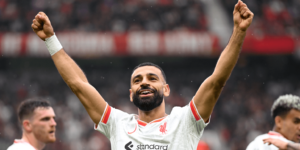
May be an image of 4 people, people playing football, people playing American football and text that says "4 26 standard chartered FIFA nлA 6 り June V YANGON, 1:10PM YANGON,1:10PMBST BST Qualifier ١ 3"

image: Virjil Van Dijk(first), Gravernberch, Mo Salah and Wataru Endo in their international duties

Van Dijk Scores in Netherlands’ Victory

Liverpool and Dutch captain Virgil van Dijk showcased his prowess in a recent friendly. Coming on as a second-half substitute, Van Dijk headed home the final goal in the Netherlands’ 4-0 win over Canada. The match, held in Rotterdam, also saw Memphis Depay, Jeremie Frimpong, and Wout Weghorst contribute to the scoreline.

Liverpool midfielder Ryan Gravenberch, another Liverpool player, put in a solid 85-minute performance in this pre-Euro 2024 fixture. However, Cody Gakpo remained an unused substitute for Ronald Koeman’s side.

Japanese Triumph Without Endo

Meanwhile, in World Cup qualifying, Wataru Endo remained on the bench for Japan. Nonetheless, his team delivered a commanding 5-0 victory over Myanmar. The match highlighted Japan’s depth and strength, even without their star midfielder on the field.

Salah Leads Egypt to Victory

Mohamed Salah played a crucial role in Egypt’s 2-1 victory over Burkina Faso. The Reds’ No.11 expertly set up Mahmoud Trezeguet’s opening goal with a well-placed ball into the box. Trezeguet went on to score twice, helping Egypt maintain a perfect record in their group. Salah’s influence was undeniable as he orchestrated the attack with precision and flair.

Koumas Debuts for Wales

Earlier in the day, young Liverpool attacker Lewis Koumas earned his first senior cap for Wales. In a friendly against Gibraltar, Koumas came on as a 73rd-minute substitute. Despite his efforts, the match ended in a goalless draw. Rob Page’s side will hope to build on this performance in future fixtures.

Transitioning into the Next Matches

As international fixtures continue, Liverpool’s players remain integral to their national teams’ successes. Van Dijk’s leadership and goal-scoring ability, combined with Salah’s creative play, highlight the Reds’ influence on the global stage. Moreover, the debut of young talents like Koumas promises a bright future for both Liverpool and their respective national teams.

Liverpool’s Prospects Post-International Break

With the international break concluding, Liverpool will look to integrate these experiences into their club performances. The players’ successes and challenges during the break provide valuable lessons and momentum. The team aims to capitalize on this and carry forward the international form into their Premier League campaign.

Focus on Fitness and Form

Maintaining fitness and form will be crucial as the players return to club duties. Arne Slot ‘s management will focus on blending the returning international stars with the rest of the squad. Ensuring a seamless transition from international to club football is essential for Liverpool’s aspirations this season.

Looking Ahead

Looking ahead, Liverpool’s players will rejoin their club with a wealth of experience and confidence gained from their international exploits. The Reds’ fans will be eager to see their heroes back in action, contributing to Liverpool’s quest for glory in the Premier League and beyond.

Conclusion

Liverpool’s players have made significant contributions to their national teams during the international break. Their performances have showcased their talents and the club’s strength. As they return to Anfield, the focus will be on building on these successes and driving Liverpool forward in the upcoming fixtures. The blend of experienced leaders and emerging talents promises an exciting phase for Liverpool FC and its supporters.


4o
Leave a Reply

Your email address will not be published. Required fields are marked *

You may have missed

Building Global Bridges for The Kenya We Want At the sidelines of the 74th National Prayer Breakfast in Washington, DC, I found myself in a space that went far beyond ceremony or symbolism. It was a moment of reflection, connection, and purposeful dialogue—one that underscored how deeply interconnected our world has become, and how Kenya’s future is inseparable from global conversations on leadership, values, and sustainable development. Joining hands with global leaders such as former South Carolina Governor and former Executive Director of the United Nations World Food Programme, David Beasley, alongside Henry Kaestner, Zac Sicher, and Gavin Gramstad, I engaged in conversations that spoke to the heart of the challenges and opportunities of our time. We discussed food security, ethical investment, values-driven leadership, and the urgent need for sustainable development models that place people at the center. These were not abstract discussions. They were grounded, practical, and focused on real outcomes for real communities—especially those in developing nations like Kenya. The National Prayer Breakfast has long been a convening space where leaders from across political, cultural, and ideological divides meet in a spirit of humility and shared humanity. In that environment, the conversations I participated in reinforced a simple but powerful truth: leadership anchored in values has the capacity to transform societies. When leaders are guided not just by power or profit, but by dignity, compassion, and responsibility, they create pathways for inclusive growth and lasting peace. Food security emerged as a central theme in our discussions. In a world of unprecedented wealth and technological advancement, it remains unacceptable that millions still go to bed hungry. For Kenya, food security is not merely an agricultural issue—it is an economic, social, and moral imperative. It affects education outcomes, health indicators, political stability, and national cohesion. Conversations with leaders who have worked at the highest levels of global food systems offered valuable insights into how strategic investment, policy coherence, and regional cooperation can help nations like ours build resilient food systems that withstand climate shocks and global market disruptions. Equally important was the discussion on investment—particularly investment that is ethical, patient, and aligned with long-term development goals. Kenya has immense potential: a youthful population, a vibrant entrepreneurial spirit, and a strategic position within Africa and the global economy. However, unlocking this potential requires more than capital flows. It demands partnerships rooted in mutual respect, transparency, and shared values. Investment must serve development, not distort it. It must create jobs, transfer skills, and strengthen local institutions rather than undermine them. These engagements reminded me that diplomacy today is no longer confined to formal negotiations or official state visits. True progress often happens on the sidelines—through honest conversations, personal relationships, and the willingness to listen and learn. Building bridges is as much about trust as it is about policy. And trust is built when leaders show consistency between their words and their actions. For Kenya, and for the millions of Kenyans at home and across the Diaspora, these global engagements carry profound significance. Our Diaspora community is a vital pillar of our national development, contributing not only remittances but also knowledge, networks, and global perspectives. Engaging the world is not about looking outward at the expense of home; it is about bringing global opportunities back to uplift our people, strengthen our institutions, and expand the horizons of what is possible for the next generation. As Party Leader of Wiper and Leader of the Azimio La Umoja One Kenya Coalition, my commitment remains unwavering. I am guided by one mission: to champion The Kenya We Want. This is a vision of a nation anchored in dignity, where every citizen feels valued and protected. A nation of opportunity, where hard work is rewarded and talent can flourish regardless of background. A nation of shared prosperity, where growth is inclusive and no community is left behind. The Kenya We Want is not a slogan. It is a call to action. It requires courageous leadership that puts country before self. It calls for unity across political, ethnic, and generational lines. It demands that we confront corruption, inequality, and injustice with honesty and resolve. And it insists that development must be sustainable—economically, socially, and environmentally—so that future generations inherit not debt and division, but hope and possibility. Our future is undeniably global. The challenges we face—climate change, food insecurity, economic volatility, and conflict—do not respect borders. Neither should our solutions. Kenya must continue to engage confidently on the global stage, contributing ideas, leadership, and partnership. At the same time, we must remain firmly rooted in our values, our culture, and our people’s aspirations. The purpose, however, is clear. Global engagement is not an end in itself. It is a means to uplift our people, to create opportunities for our youth, to empower women, to support farmers, workers, and entrepreneurs, and to ensure that every Kenyan can live a life of dignity. When we engage the world with clarity of purpose, we turn dialogue into action and partnerships into progress. Moments like the National Prayer Breakfast serve as reminders that leadership is ultimately about service. It is about stewarding trust, building consensus, and leaving a legacy that extends beyond individual ambition. As Kenya navigates a complex global landscape, we must remain steadfast in our values and bold in our vision. Our future is global. Our purpose is clear. And together—at home and across the Diaspora—we will continue working toward The Kenya We Want: a nation confident in itself, respected in the world, and united in its pursuit of dignity, opportunity, and shared prosperity. 🇰🇪🌍

Social Media Auto Publish Powered By : XYZScripts.com