Denmark holds England
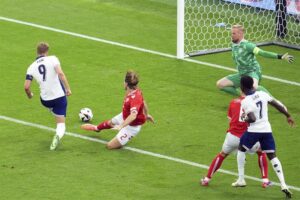
England’s Harry Kane, left, scores the opening goal during a Group C match between Denmark and England at the Euro 2024 soccer tournament in Frankfurt, Germany, Thursday, June 20, 2024.
England Misses Knockout Stage Guarantee
England failed to secure their place in the knockout stages of Euro 2024 after Morten Hjulmand’s spectacular strike earned Denmark a 1-1 draw on Thursday. A point was the least the Danes deserved as England flattered to deceive in Frankfurt, following an underwhelming 1-0 win over Serbia to open their tournament. Harry Kane gave the Three Lions an early lead by capitalizing on a Danish defensive error.
England’s Harry Kane, left, scores the opening goal during a Group C match between Denmark and England at the Euro 2024 soccer tournament in Frankfurt, Germany, Thursday, June 20, 2024.
Danish Resilience and Late Chances
Hjulmand’s rocket from outside the box leveled the score before half-time. Denmark rued missing late chances to secure a famous victory. Despite the draw, England remains on top of Group C two points clear of Slovenia, who they will face in Cologne on Tuesday. Denmark also shares the same points as Slovenia. Serbia’s late equalizer in a 1-1 draw with Slovenia earlier on Thursday keeps their destiny in their own hands.
Southgate’s Media Avoidance and Expected Criticism
England boss Gareth Southgate mentioned on Wednesday that he avoids media coverage during tournaments to escape negative stories. However, he must brace for more criticism after another flat display from one of the pre-tournament favorites. Denmark’s coach Kasper Hjulmand and goalkeeper Kasper Schmeichel claimed on the eve of the game that they would not be fueled by revenge for their Euro 2020 semi-final heartbreak to England three years ago. Yet, the Danes showcased a different level of performance from the side that disappointed at the 2022 World Cup and drew against Slovenia in their tournament opener in Germany.
Early Struggles and Kane’s Opener
Denmark started brighter as both sides struggled with a bobbly pitch in Frankfurt that deteriorated quickly in its second game of five at Euro 2024. England capitalized on a defensive error from Denmark to take the lead at 18 minutes. Victor Kristiansen was caught unaware of Kyle Walker‘s run down the right, and his deflected low cross fell perfectly for Kane to roll in his 13th goal at major tournaments.
England’s Consistent Criticism
Failing to build on early 1-0 leads has been a consistent criticism of England under Southgate. In the 2018 World Cup semi-final and the Euro 2020 final, Croatia and Italy managed to wrestle away momentum from the Three Lions. This time, Denmark was not deterred by conceding, although it took a spectacular strike to bring them level. Hjulmand found far too much room given by the England midfield, taking full advantage with a blistering shot that clipped the inside of the post on its way in.
Southgate’s Tactical Decisions
Southgate made no changes at the break, but the future of his experiment of playing Liverpool right-back Trent Alexander-Arnold in a midfield role is in doubt after he was substituted for Conor Gallagher on 55 minutes. Phil Foden’s form for England has been a topic of much debate. After failing to shine against Serbia, the Manchester City playmaker looked more like the man who won Premier League Player of the Year awards this season and was inches away from restoring England’s lead with a low drive that crashed off the post.
Bold Substitutions and Missed Opportunities
Southgate’s caution has been criticized in the past, but he made bold changes in the search for a winner as Kane, Foden, and Bukayo Saka were replaced by Eberechi Eze, Ollie Watkins, and Jarrod Bowen. Watkins nearly made an immediate impact but was denied by Schmeichel after a brilliant through ball from Jude Bellingham. Yet, Denmark had the better chances to take all three points in the closing stages. Andreas Christensen spooned over when unmarked from a corner before Pierre-Emile Hojbjerg curled inches wide.
Denmark’s Tactical Edge
Denmark’s tactical setup proved effective in nullifying England’s attacking threats. The Danes pressed high and maintained a compact defensive structure, making it difficult for England to create clear-cut chances. Despite conceding early, Denmark remained composed and focused on their game plan. This resilience and tactical discipline allowed them to secure a valuable point and keep their hopes alive in the tournament.
England’s Midfield Struggles
England’s midfield struggled to control the game, often losing possession in crucial areas. This lack of control allowed Denmark to exploit spaces and launch counter-attacks. Southgate’s decision to start with a more conservative midfield setup backfired as England lacked creativity and dynamism in the middle of the park. The introduction of Gallagher and other substitutes brought some energy, but it was not enough to secure a victory.
Looking Ahead to Next Matches
Both teams now look ahead to their next matches with different objectives. England aims to secure a win against Slovenia to guarantee their place in the knockout stages, while Denmark will hope to build on their performance and secure a win to boost their chances of progressing. The outcome of these matches will be crucial in determining the final standings in Group C.
Fan Reactions and Social Media
Fans and pundits took to social media to express their opinions on the match. Many criticized Southgate’s tactics and questioned his ability to lead England to success. Others praised Denmark’s resilience and tactical astuteness. The debate over Southgate’s future continues to be a hot topic as England fans demand better performances from their team.
The 1-1 draw between England and Denmark highlighted the strengths and weaknesses of both teams. England’s inability to build on early leads and their midfield struggles remain areas of concern. Meanwhile, Denmark’s resilience and tactical discipline earned them a deserved point. As the tournament progresses, both teams will need to address their shortcomings and build on their strengths to achieve their goals.
For more detailed coverage and analysis, visit the Euro 2024 official site and BBC Sport. Keep updated on England’s journey by following the England National Football Team’s official page. For more on Denmark’s tactics and performances, visit the Danish Football Association.