Defending the Starehe Model: Why Context Matters in the Debate Over Fees, Audits, and Accountability
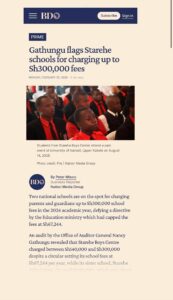
A growing public debate around Starehe Boys Centre and School has sparked strong reactions, particularly following recent audit-related narratives that portray the institution as a typical public national school charging “illegal” or excessive fees. However, voices familiar with Starehe’s history, structure, and mission argue that such framing is misleading and risks damaging one of Kenya’s most impactful education institutions.
One such voice is Paul Njuguna, whose perspective resonates with many alumni and supporters of Starehe. The concern raised is not about shielding Starehe from accountability—because accountability is essential for all institutions—but about the lack of context and nuance in how the public conversation is being shaped.
At the heart of the issue is a fundamental question that critics say should have been asked at the very beginning: Is Starehe Boys Centre and School a fully government-funded public institution? The answer is no. Starehe is a unique philanthropic institution with a hybrid funding model that has evolved over decades. While the government pays the salaries of about 60 teachers and offers some support as a gesture of goodwill, the school shoulders enormous operational costs that go far beyond what most public schools manage. Starehe pays additional staff, maintains extensive welfare programs, and supports students in ways that are uncommon in conventional public institutions.
By treating Starehe as a standard national school in audit reports and public discourse, critics argue that authorities risk creating a false narrative. This approach fails to acknowledge Starehe’s endowment-based and donor-supported model, potentially discouraging well-wishers and donors whose contributions are vital to keeping the institution alive. For a school that depends heavily on goodwill and philanthropy, reputational harm can translate directly into reduced support for vulnerable students.
A major point of controversy has been the widely publicized figure of KSh 300,000 in fees. Supporters of the Starehe model argue that this figure has been presented without sufficient explanation. Historically, Starehe has educated boys—and now girls—from disadvantaged backgrounds entirely free of charge. This mission remains central to its identity. However, the global philanthropic landscape has changed. Traditional sponsors and international donor ecosystems that once sustained institutions like Starehe are no longer as reliable or abundant.
Faced with shrinking sponsorships and a persistent demand from needy children, Starehe adopted and refined a cross-subsidy approach through what is known as Category C or fee-paying students. Under this model, parents who are financially able and whose children qualify academically may choose to pay higher fees. This is not a case of coercion or elitism, supporters say, but a strategic survival mechanism. Those who can pay more do so willingly, understanding that their contribution helps sustain the broader Starehe mission.
Funds from fee-paying students are used to support the school’s extensive welfare system. This includes providing uniforms, meals, medical care, books, salaries for teachers and support staff, dormitory operations, transport assistance, pocket money, and full or partial sponsorship for students who cannot afford to pay. In essence, those with means help educate those without—an approach that mirrors how many successful institutions around the world operate.
Importantly, financial contribution alone does not define the Category C model. Integration is a core principle of Starehe. To this day, approximately 70% of students are fully sponsored or heavily subsidized. This means the majority of learners still benefit directly from the school’s welfare-based philosophy. This structure is not a recent invention to justify higher fees; it dates back to the school’s founding under Dr. Geoffrey Griffin. From the beginning, Starehe was designed to deliberately mix students from diverse economic and social backgrounds.
This integration—bringing together the privileged and the vulnerable, the well-connected and the unknown—is widely credited as one of Starehe’s greatest strengths. It creates a unique social fabric that fosters equality, dignity, and national unity. Alumni often speak of growing up together, sharing the same dormitories, meals, discipline, and values, regardless of background.
Personal testimonies from former students underscore this impact. Many went through the Starehe system entirely free of charge for over a decade, receiving not only education but holistic support, including travel assistance, pocket money, and even accommodation after finishing school. For them, Starehe was not just a place of learning—it was a home that raised leaders, built confidence, and opened doors that would otherwise have remained closed.
Supporters therefore urge that discussions around Starehe’s fees and audits should not be driven by headlines or political populism. Instead, they call for engagement with the Board, a deeper understanding of the endowment fund model, and consultation with alumni, donors, and well-wishers who sustain the institution.
While accountability remains non-negotiable, many argue it must be intelligent, fair, and grounded in context. Without that balance, Kenya risks undermining a national asset that has, for decades, served as a ladder out of poverty, a leadership factory, and one of the country’s most successful education experiments.
For countless alumni, their lives and opportunities are a testament to the Starehe vision conceived by Geoffrey Griffin—a vision they believe deserves understanding, protection, and thoughtful stewardship rather than simplistic condemnation.