Chinese Kindergartens Transform to Senior Centers

0

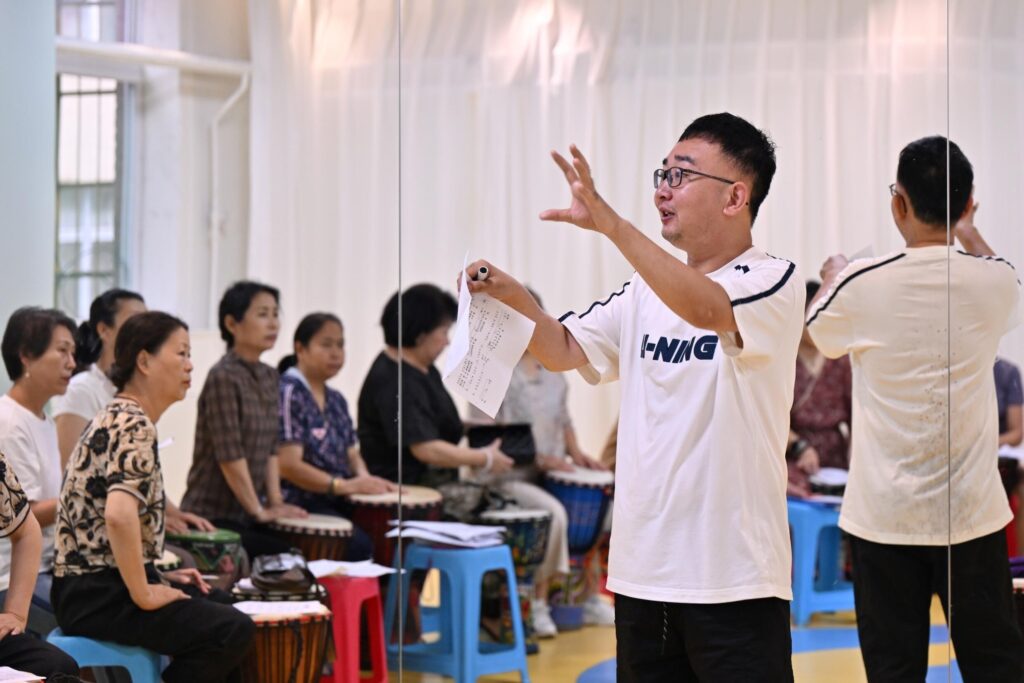
This picture taken on July 2, 2024 shows Lei Fangyan (R) gesturing as he teaches African drums at a kindergarten-turned-elderly centre in Taiyuan, in China’s northern Shanxi province. 

A New Chapter for Kindergartens

In northern China, senior citizens dance to old-time tunes at a former kindergarten. Educators have shifted focus from children to seniors due to the aging population and low birth rate. This change reflects a nationwide trend as China’s demographics evolve rapidly.

Facing Demographic Changes

Official statistics reveal that hundreds of millions of Chinese will enter old age in the coming decades. Meanwhile, the country’s birth rate remains chronically low. This demographic shift affects many sectors, including education. Thousands of preschools have closed as enrollments decline. However, some institutions have adapted, like one in Shanxi province.

Transformation in Shanxi

In Shanxi, a kindergarten has transitioned to a senior care center. Principal Li Xiuling, 56, shared her experience. “The problem became evident as the number of children decreased,” she said. Her preschool, founded in 2005, once served 280 children but closed last year. It reopened in December as “Impressions of Youth,” a recreational center for retirees. Now, around 100 adult learners engage in music, dance, and other activities.

Embracing New Opportunities

Li believes this change is progressive. “They come to fulfill dreams they had when young,” she said. On a rainy morning, a modeling instructor led older women in traditional dresses around a classroom. In another class, students played African drums to socialist songs. He Ying, 63, found new confidence and friends at the center. “I used to feel my cultural life was impoverished,” she said. “People here are not just waiting to grow old.”

Nationwide Trend

Nearly 15,000 kindergartens closed last year as enrollments dropped by 5.3 million. In industrial Shanxi, deaths outnumbered births by 78,000 last year. The center’s past remains visible with bunk beds and desks in former classrooms. Yan Xi, who now teaches retirees, found the transition challenging. “Little kids believe whatever you say, but the elderly have their own ways,” she said.

Senior Education on the Rise

Several facilities in China have successfully pivoted from preschool to senior education. Student Sun Linzhi, 56, sees this shift as meeting a need for “universities for the elderly.” Since joining the center, Sun feels rejuvenated. “I feel like I’m young again,” she said.

The Growing “Silver Economy”

China’s senior population rose by nearly 17 million last year. Seniors now make up over 20 percent of the population. This proportion could reach nearly a third by 2035. Beijing plans to establish a national elderly care system by 2025. However, the country still lacks enough nursing homes and faces regional disparities. Top leaders are discussing the “silver economy” at a key economic meeting. The government estimates that senior-related products and services could be worth 30 trillion yuan by 2035.

Nostalgia and Adaptation

Li, the principal, feels nostalgic for the days when her school was full of children. “I was very emotionally invested in it,” she said, gesturing towards the disused bunks and desks. “We kept those as a kind of memento.”

China’s kindergartens are transforming to meet the needs of an aging population. This shift highlights the country’s demographic challenges and the innovative responses emerging. As senior citizens find new opportunities in these converted centers, the nation continues to adapt to its changing population.

Leave a Reply

Your email address will not be published. Required fields are marked *

You may have missed

Building Global Bridges for The Kenya We Want At the sidelines of the 74th National Prayer Breakfast in Washington, DC, I found myself in a space that went far beyond ceremony or symbolism. It was a moment of reflection, connection, and purposeful dialogue—one that underscored how deeply interconnected our world has become, and how Kenya’s future is inseparable from global conversations on leadership, values, and sustainable development. Joining hands with global leaders such as former South Carolina Governor and former Executive Director of the United Nations World Food Programme, David Beasley, alongside Henry Kaestner, Zac Sicher, and Gavin Gramstad, I engaged in conversations that spoke to the heart of the challenges and opportunities of our time. We discussed food security, ethical investment, values-driven leadership, and the urgent need for sustainable development models that place people at the center. These were not abstract discussions. They were grounded, practical, and focused on real outcomes for real communities—especially those in developing nations like Kenya. The National Prayer Breakfast has long been a convening space where leaders from across political, cultural, and ideological divides meet in a spirit of humility and shared humanity. In that environment, the conversations I participated in reinforced a simple but powerful truth: leadership anchored in values has the capacity to transform societies. When leaders are guided not just by power or profit, but by dignity, compassion, and responsibility, they create pathways for inclusive growth and lasting peace. Food security emerged as a central theme in our discussions. In a world of unprecedented wealth and technological advancement, it remains unacceptable that millions still go to bed hungry. For Kenya, food security is not merely an agricultural issue—it is an economic, social, and moral imperative. It affects education outcomes, health indicators, political stability, and national cohesion. Conversations with leaders who have worked at the highest levels of global food systems offered valuable insights into how strategic investment, policy coherence, and regional cooperation can help nations like ours build resilient food systems that withstand climate shocks and global market disruptions. Equally important was the discussion on investment—particularly investment that is ethical, patient, and aligned with long-term development goals. Kenya has immense potential: a youthful population, a vibrant entrepreneurial spirit, and a strategic position within Africa and the global economy. However, unlocking this potential requires more than capital flows. It demands partnerships rooted in mutual respect, transparency, and shared values. Investment must serve development, not distort it. It must create jobs, transfer skills, and strengthen local institutions rather than undermine them. These engagements reminded me that diplomacy today is no longer confined to formal negotiations or official state visits. True progress often happens on the sidelines—through honest conversations, personal relationships, and the willingness to listen and learn. Building bridges is as much about trust as it is about policy. And trust is built when leaders show consistency between their words and their actions. For Kenya, and for the millions of Kenyans at home and across the Diaspora, these global engagements carry profound significance. Our Diaspora community is a vital pillar of our national development, contributing not only remittances but also knowledge, networks, and global perspectives. Engaging the world is not about looking outward at the expense of home; it is about bringing global opportunities back to uplift our people, strengthen our institutions, and expand the horizons of what is possible for the next generation. As Party Leader of Wiper and Leader of the Azimio La Umoja One Kenya Coalition, my commitment remains unwavering. I am guided by one mission: to champion The Kenya We Want. This is a vision of a nation anchored in dignity, where every citizen feels valued and protected. A nation of opportunity, where hard work is rewarded and talent can flourish regardless of background. A nation of shared prosperity, where growth is inclusive and no community is left behind. The Kenya We Want is not a slogan. It is a call to action. It requires courageous leadership that puts country before self. It calls for unity across political, ethnic, and generational lines. It demands that we confront corruption, inequality, and injustice with honesty and resolve. And it insists that development must be sustainable—economically, socially, and environmentally—so that future generations inherit not debt and division, but hope and possibility. Our future is undeniably global. The challenges we face—climate change, food insecurity, economic volatility, and conflict—do not respect borders. Neither should our solutions. Kenya must continue to engage confidently on the global stage, contributing ideas, leadership, and partnership. At the same time, we must remain firmly rooted in our values, our culture, and our people’s aspirations. The purpose, however, is clear. Global engagement is not an end in itself. It is a means to uplift our people, to create opportunities for our youth, to empower women, to support farmers, workers, and entrepreneurs, and to ensure that every Kenyan can live a life of dignity. When we engage the world with clarity of purpose, we turn dialogue into action and partnerships into progress. Moments like the National Prayer Breakfast serve as reminders that leadership is ultimately about service. It is about stewarding trust, building consensus, and leaving a legacy that extends beyond individual ambition. As Kenya navigates a complex global landscape, we must remain steadfast in our values and bold in our vision. Our future is global. Our purpose is clear. And together—at home and across the Diaspora—we will continue working toward The Kenya We Want: a nation confident in itself, respected in the world, and united in its pursuit of dignity, opportunity, and shared prosperity. 🇰🇪🌍

Social Media Auto Publish Powered By : XYZScripts.com