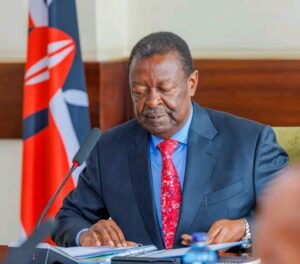
Musalia Mudawadi Appeals ANC-UDA Merger
Kenyan Prime Minister Musalia Mudawadi has formally appealed to the Court of Appeal, seeking to overturn a landmark ruling by the High Court that dissolved the National Peace Congress and terminated its alliance with the United Democratic Alliance (UDA). This move has once again drawn attention to Kenya’s political landscape.
This legal battle has sparked heated debate in political circles. Analysts point out that the outcome could significantly alter the future direction of party mergers and alliance politics in Kenya. At the heart of the dispute lies whether the ANC-UDA merger process complied with the democratic procedures stipulated by the constitution, party charter, and law.
The High Court’s ruling shook Kenya’s political system. The ruling declared the dissolution of the ANC and its subsequent merger with the UDA unconstitutional, illegal, and invalid. The judges ruled that the process allegedly failed to meet legal requirements and did not adequately involve party members and key members of the political organization. The court’s ruling is seen as a major blow to Mudawadi, a close ally of President William Ruto and a key figure in Kenya’s Kwanzaa government. Previously, Mudawadi had defended the merger, insisting it was a strategic political decision aimed at strengthening unity within the ruling coalition and consolidating support.
In his appeal, Mudawadi argued that the High Court misinterpreted the law and failed to grasp the political realities behind the party merger. His legal team insisted that all constitutional procedures had been followed and that the merger had been approved by the party’s legal system.
According to documents submitted to the Court of Appeal, the former ANC leader stated that party members participated in the consultations and that representatives supported the decision to merge with the UDA. He also argued that dissolving the coalition would cause division among supporters and weaken political activity within the ruling coalition.
The issue has attracted widespread attention because the ANC was once one of the most influential political parties in western Kenya. Mudawadi founded the party, built a strong support base, and played a key role in Kenyan coalition politics for many years. The party’s dissolution marks the end of an era for many loyal supporters who viewed the ANC as a symbol of regional political identity.
Critics point out that the ANC was dissolved swiftly without considering its core party. Some party officials and supporters claimed they were marginalized at key meetings and accused top leaders of imposing decisions from the top down. They argued that the coalition government undermined internal democracy and disregarded the wishes of ordinary party members.
The High Court acknowledged these concerns, emphasizing that political parties are public institutions bound by constitutional principles and cannot be arbitrarily dissolved. The judge stressed that any major political decision, especially in the case of dissolving a party, must follow due process, be transparent, and involve party members.
However, Mudawadi and supporters of the United Democratic Alliance (UDA) criticized the decision, arguing that it violated political freedoms and the right of parties to form strategic alliances. They argued that forming alliances was necessary to strengthen Kwanza governance in Kenya and establish a more unified governance structure.
Political experts say this appeal could be one of the most important constitutional and political cases in recent years. The appeals court must now determine whether the High Court overstepped its authority or whether its interpretation of party-related laws was correct.
The outcome of the appeal could have significant implications for other parties considering mergers or alliances, especially ahead of the next election. Legal experts say the ruling could set an important recedent for how parties in Kenya’s multi-party democracy can legally dissolve, merge, or reorganize.
For Mudawadi, this case is also a political signal. Once considered a presidential candidate and regional “kingmaker,” he has worked for years to solidify his position on the national political stage. His cooperation with President Ruto in the 2022 general election significantly boosted support for Kwanza in parts of western Kenya.
Therefore, the alliance between the ANC and the United Democratic Alliance (UDA) is not merely a bureaucratic maneuver; it represents a major political shift aimed at consolidating power within the ruling coalition. Changing the status quo could reignite political tensions and deepen divisions between leaders and supporters who have accepted the new arrangements.
Within the UDA, leaders are confident of a successful appeal. They stated that the merger was conducted within an open and legal framework. Some officials accused critics of using the courts to advance political interests rather than genuinely addressing constitutional issues.
Meanwhile, opposition leaders and ruling party activists welcomed the High Court’s ruling, arguing that it strengthened democracy and protected party members from the influence of unilateral decisions by political elites. They argued that political parties should be accountable to their members and not controlled by a minority like private entities.
As the legal battle moves to the Court of Appeals, the Kenyan public is closely watching developments. Intense legal debates are expected, with constitutional lawyers, political analysts, and party supporters closely monitoring every step of the case.
The appeals process may also test the relationship between law and politics in Kenya, where court rulings have an increasingly significant impact on major political events. In recent years, the courts have become a powerful force, with their major decisions capable of swaying the country’s political direction.
Whether the Court of Appeals upholds or overturns the High Court’s ruling, it will undoubtedly leave a significant mark on Kenyan political history. For Mudawadi, this appeal is not only about saving the ruling coalition but also about defending his political legacy and influence within the ruling party. For ANC supporters, this case has sparked painful anxieties about the future of the party that once carried the hopes of thousands of its members. For Kenya’s democratic system, this struggle may change how political parties make major decisions in the future.
Now, the nation’s attention is focused on the Court of Appeal, awaiting the next phase of this protracted alliance battle between the ANC and the United Democratic Alliance (UDA).