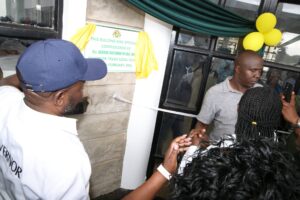
Governor Natembeya Commissions Sh145 Million Mother and Baby Hospital in Kitale, Strengthening Maternal and Child Healthcare in Trans Nzoia
HENRY MASINDE February 9, 2026 0The County Government of Trans Nzoia has marked a major milestone in the expansion of healthcare services following the commissioning of the St. Teresa Mother and Baby Hospital in Kitale. The facility, formerly known as Tomboya Hospital, is located in Tuwan Ward, Saboti Sub-County, and is expected to significantly improve access to quality maternal and child healthcare services for thousands of residents across the county.
The hospital was officially opened by Trans Nzoia Governor George Natembeya, who described the project as a landmark achievement in the county’s health sector and a clear demonstration of efficient service delivery. Constructed at a cost of Sh145 million, the hospital was developed through a partnership between the County Government of Trans Nzoia and the World Bank under the Kenya Devolution Support Programme Phase I (KDSP I).
In addition to construction costs, the county invested an extra Sh54 million in modern medical equipment and oxygen piping systems, ensuring the facility is fully equipped to provide comprehensive maternal, neonatal, and child health services. The hospital is projected to serve a population of more than 120,000 people from Saboti Sub-County and surrounding areas, while handling over 500 deliveries every month.
Speaking during the commissioning ceremony, Governor Natembeya noted that the hospital was completed within a remarkably short period, reflecting the county’s commitment to improving healthcare infrastructure.
“We broke ground for this hospital in March 2023, and by November 2025 it was complete and handed over to the county. That is what commitment to service delivery looks like,” the governor said.
He emphasized that the new facility would help reduce maternal and infant mortality rates by bringing quality healthcare services closer to communities that previously had to travel long distances to access care. According to the governor, the hospital will also play a critical role in decongesting referral facilities, particularly the Kijana Wamalwa Teaching and Referral Hospital in Kitale.
“This hospital will handle more than 500 deliveries every month. It will ease the burden on referral hospitals and ensure our mothers and babies receive quality care closer to home,” Governor Natembeya added.
County health officials said the establishment of the St. Teresa Mother and Baby Hospital is part of a broader strategy to strengthen primary and secondary healthcare services, increase skilled birth attendance, and improve reproductive, maternal, newborn, child, and adolescent health outcomes. The facility is expected to drastically reduce the risks associated with home deliveries and late referrals, especially in rural and peri-urban areas.
County Executive Committee Member (CECM) for Health and Sanitation, Joseph Lorot, termed the hospital a “game changer” for Trans Nzoia’s healthcare system. He noted that residents from Tuwan, Matisi, Shanti, Kipsongo, and Mitume areas will now access essential maternal and child health services without the need to travel to far-off facilities.
“This hospital will drastically improve service delivery for mothers and children. Residents from these areas will no longer endure long journeys to seek care, especially during emergencies,” Lorot said.
He further explained that the facility would help decongest Kijana Wamalwa Teaching and Referral Hospital, enabling faster service delivery and improved efficiency across the county’s health system.
“We thank the World Bank for their continuous support. This hospital is now fully operational and ready to offer deliveries, vaccinations, diagnostic services, and comprehensive maternal and child healthcare,” he added.
County Chief Officer for Health, Dr. Judith Baraza, said the county government is prioritizing staffing to ensure the hospital operates at full capacity. She noted that plans are already underway to recruit additional qualified health workers and specialized personnel to maximize the facility’s impact.
“We are prioritizing the recruitment of skilled and qualified healthcare workers to ensure residents receive quality and timely services. This is especially important for people living in informal settlements, who often face the greatest barriers to accessing healthcare,” Dr. Baraza said.
Director of Medical Services, Dr. Isaac Babu, urged residents to make full use of the newly commissioned hospital, emphasizing that early health-seeking behavior is critical in preventing complications during pregnancy and childbirth.
“This is a world-class hospital equipped with modern technology. We encourage families to utilize these services and seek care early to protect both mothers and children,” he said.
The commissioning ceremony also witnessed a significant boost to Trans Nzoia’s healthcare infrastructure through a donation of medical and ICT equipment worth Sh14 million (approximately $108,000) from AMPATH Uzima, with support from the United States Government. The donation included an AI-powered digital X-ray machine aimed at improving tuberculosis (TB) diagnosis among both adults and children.
In addition, computers were donated to support the rollout of Electronic Medical Records (EMR) across 73 health facilities in the county, a move expected to enhance patient data management, continuity of care, and overall health system efficiency.
Handing over the equipment, AMPATH Uzima Chief of Party, Prof. Sylvester Kimaiyo, said the investment would significantly strengthen disease detection and patient care services in the county.
“The digital X-ray machine will greatly improve TB diagnosis and early screening, while the ICT equipment will enhance electronic medical records across the county,” Prof. Kimaiyo said.
He added that the partnership between AMPATH Uzima and the County Government of Trans Nzoia continues to play a vital role in strengthening health systems and improving the quality of care for people living with HIV, TB, and non-communicable diseases.
With its modern infrastructure, increased service capacity, and integration of advanced medical technology, the St. Teresa Mother and Baby Hospital represents a major step forward in expanding access to quality healthcare in Trans Nzoia County. County leaders expressed optimism that the facility will not only save lives but also restore public confidence in government healthcare services.
For thousands of mothers and children in Saboti Sub-County and surrounding communities, the new hospital represents more than just a building—it offers hope, dignity, and the assurance of quality healthcare closer to home.