KES 200 Billion and Still Thirsty: A Cry for Justice, Accountability, and Dignity in Wajir County
Sinc
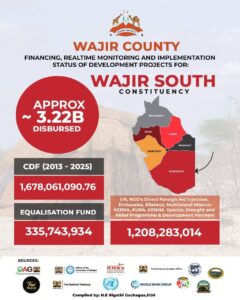
 e the introduction of devolution in Kenya in 2013, Wajir County has received nearly KES 200 billion in public funds intended to transform the lives of its people. These funds were meant to address long-standing challenges such as water scarcity, poor infrastructure, lack of electricity, inadequate sanitation, and weak healthcare systems. Yet, more than a decade later, the reality on the ground tells a painful and troubling story. By the Governor’s own admission, Wajir remains unattractive, characterized by poor infrastructure, ungoverned spaces, and limited access to electricity. This admission raises a critical question: how can a county that has received such enormous financial resources still lack the most basic necessities of life?
It is deeply concerning that a sitting two-term Governor, who also serves as the Chairman of the Council of Governors, would describe his own county in such dire terms after presiding over the expenditure of nearly KES 200 billion. These resources were entrusted to county leadership with the expectation that they would alleviate suffering and uplift the lives of Reer Wajir. Instead, the people continue to endure conditions that deny them human dignity and basic survival.
One of the most painful examples of this failure is the persistent and recurring water crisis. Water is not a luxury; it is life itself. Yet, families in Wajir — including women, children, orphans, widows, and the broader Ummah — continue to walk long distances every single day in search of this most basic necessity. It is difficult to comprehend how the county leadership could not allocate even 0.02% of its total budget — just two shillings out of every thousand — to meaningfully address this perennial problem. This reality forces the people to question priorities, commitment, and compassion in leadership.
As the Holy Month of Ramadan approaches, this failure feels even more painful. Ramadan is a time of reflection, mercy, and compassion, yet many families in Wajir are preparing to face it without water, without decent sanitation, without electricity, and without functional healthcare facilities. These are not demands for comfort or luxury. They are the bare minimum required for human life, dignity, and survival. To deny people these basics is to deny them their humanity.
The frustration of Reer Wajir is further compounded by the visible disconnect between leadership rhetoric and lived reality. Leadership is not measured by frequent media appearances in Nairobi or by hopping from one radio station to another. True leadership is judged by tangible impact — by the condition of the people